
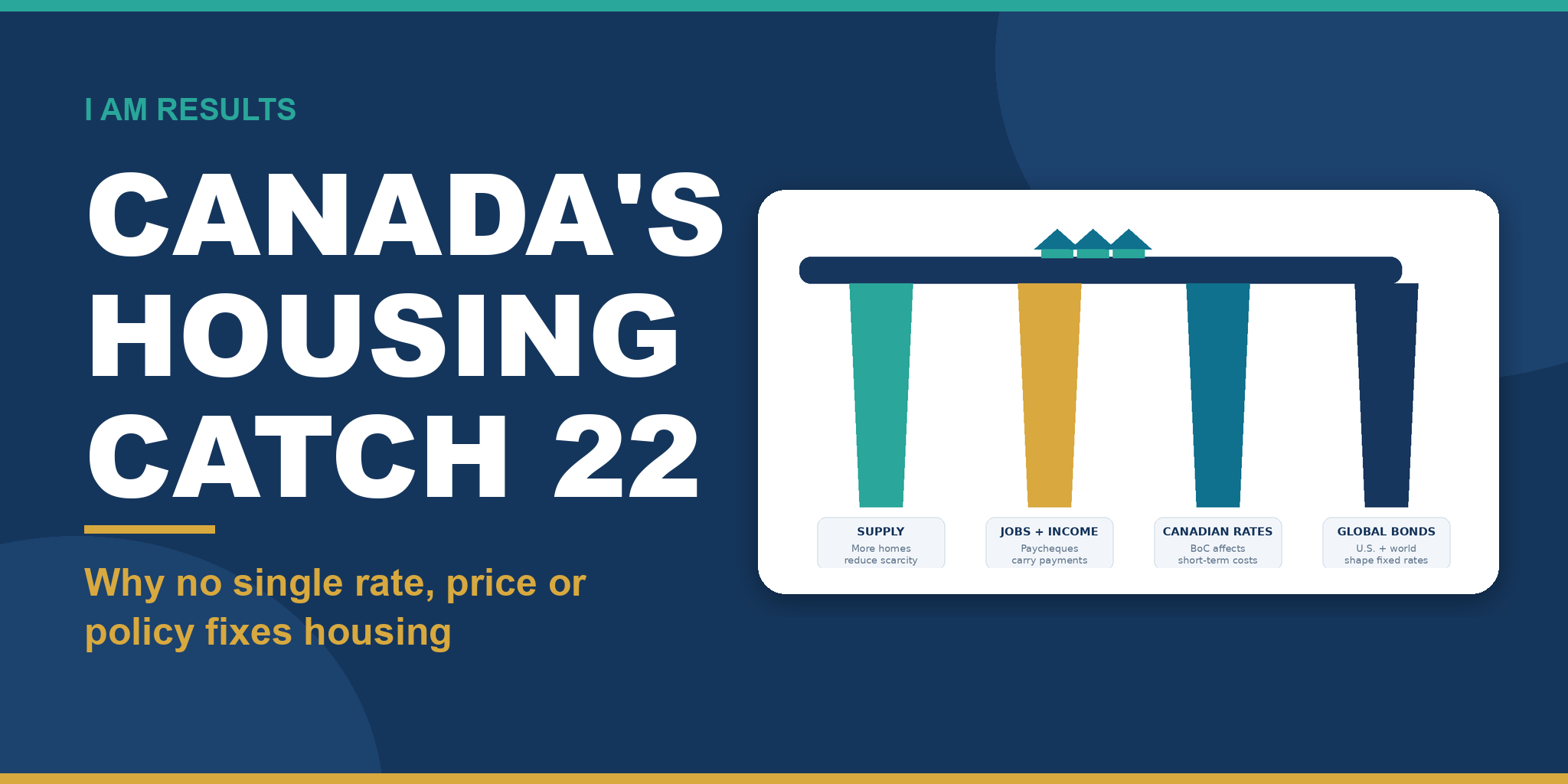
I AM RESULTS
A plain-language guide to supply, jobs, interest rates, global bond markets and homeowner equity
CONFIDENT DECISIONS THROUGH CLARITY
Updated October 29, 2026 | Educational information, not personal mortgage advice
The whole report in one page
It has several problems pulling against each other at the same time. Fix one too quickly and you can make another worse.
If you remember only one thing from this report, remember the table analogy:
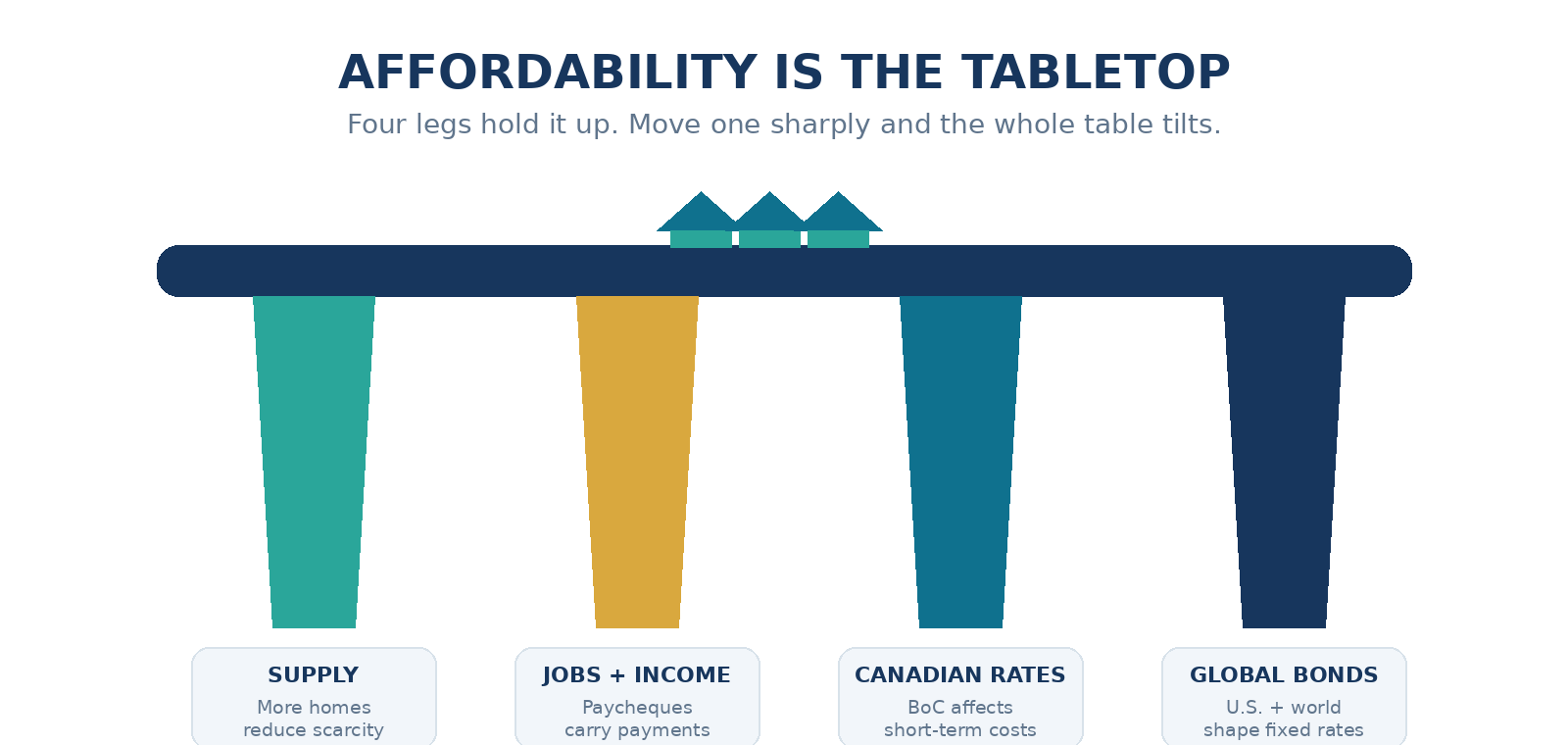
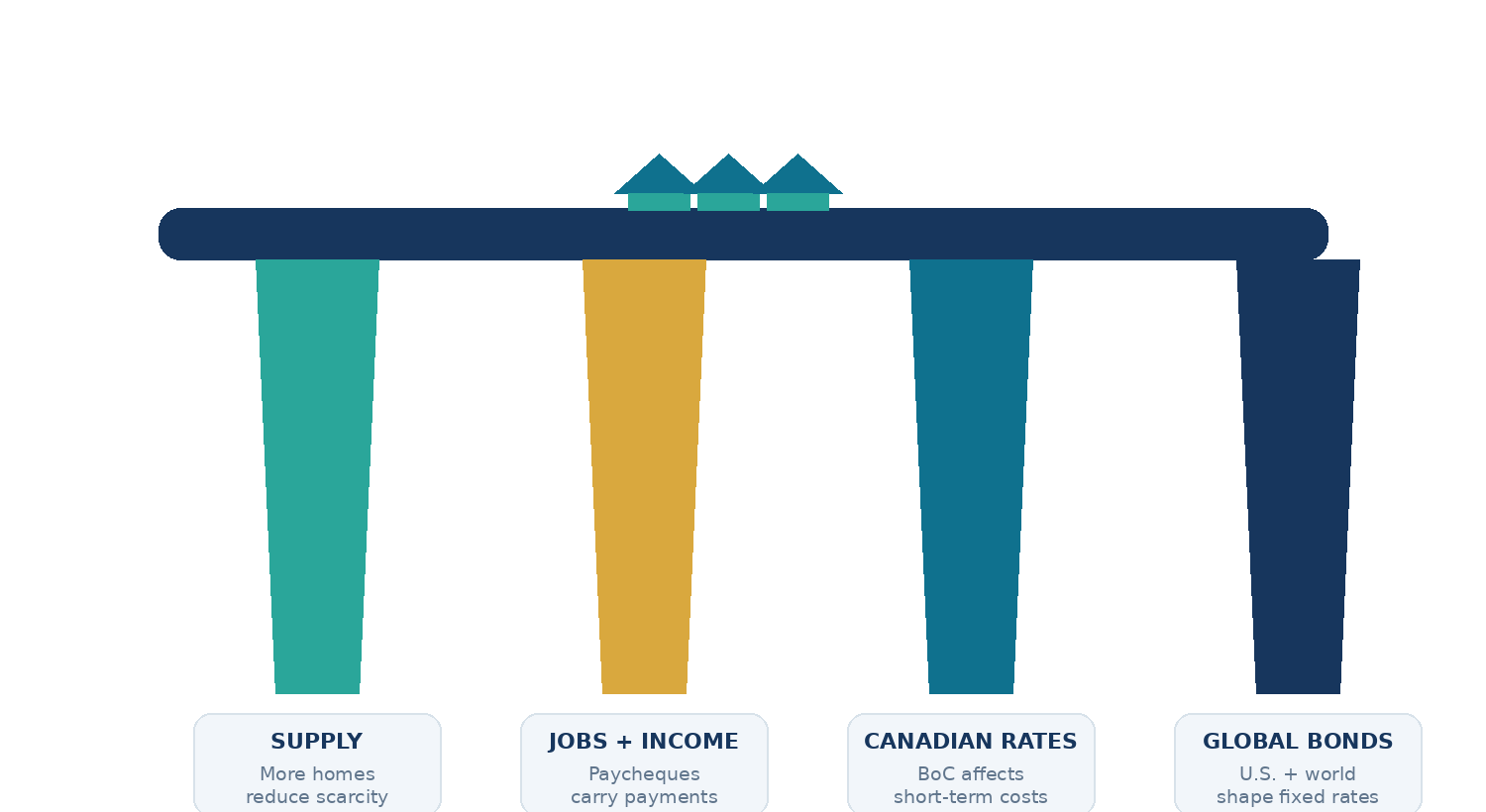
The tabletop is housing affordability. The four legs holding it up are housing supply, jobs and incomes, Canadian borrowing costs, and the global bond market. If one leg moves sharply before the others adjust, the table tilts.
You do not need to predict the economy perfectly. You need to make a housing or mortgage decision that can survive if your prediction is wrong.
1. The four-legged table
Most housing headlines focus on one thing at a time: rates, prices, construction, unemployment, inflation. The problem is that Canadians live with all of them at once.
Canada needs far more homes. More supply reduces scarcity, but homes take years to approve, finance and build.
A cheaper home is not affordable if the buyer loses a job. Incomes and employment determine whether households can actually carry the payment.
The Bank of Canada strongly influences prime and variable-rate borrowing. Higher rates cool demand, but they also raise carrying and construction costs.
Fixed mortgage rates are influenced by government bond yields and lender funding. U.S. inflation, U.S. growth and global borrowing can keep those yields high even when Canada would prefer relief.
That is the Catch 22. Canada can improve one leg and still make the table wobble somewhere else.
- Lower rates can relieve borrowers, but bring buyers back faster than new homes can be built.
- Higher rates can cool prices, but make construction financing harder and strain existing homeowners.
- Falling prices can help buyers, but reduce the equity cushion of recent high loan-to-value owners.
- A weaker economy can reduce housing demand, but unemployment can make even cheaper homes harder to buy.
2. Leg 1: Canada still does not build enough homes
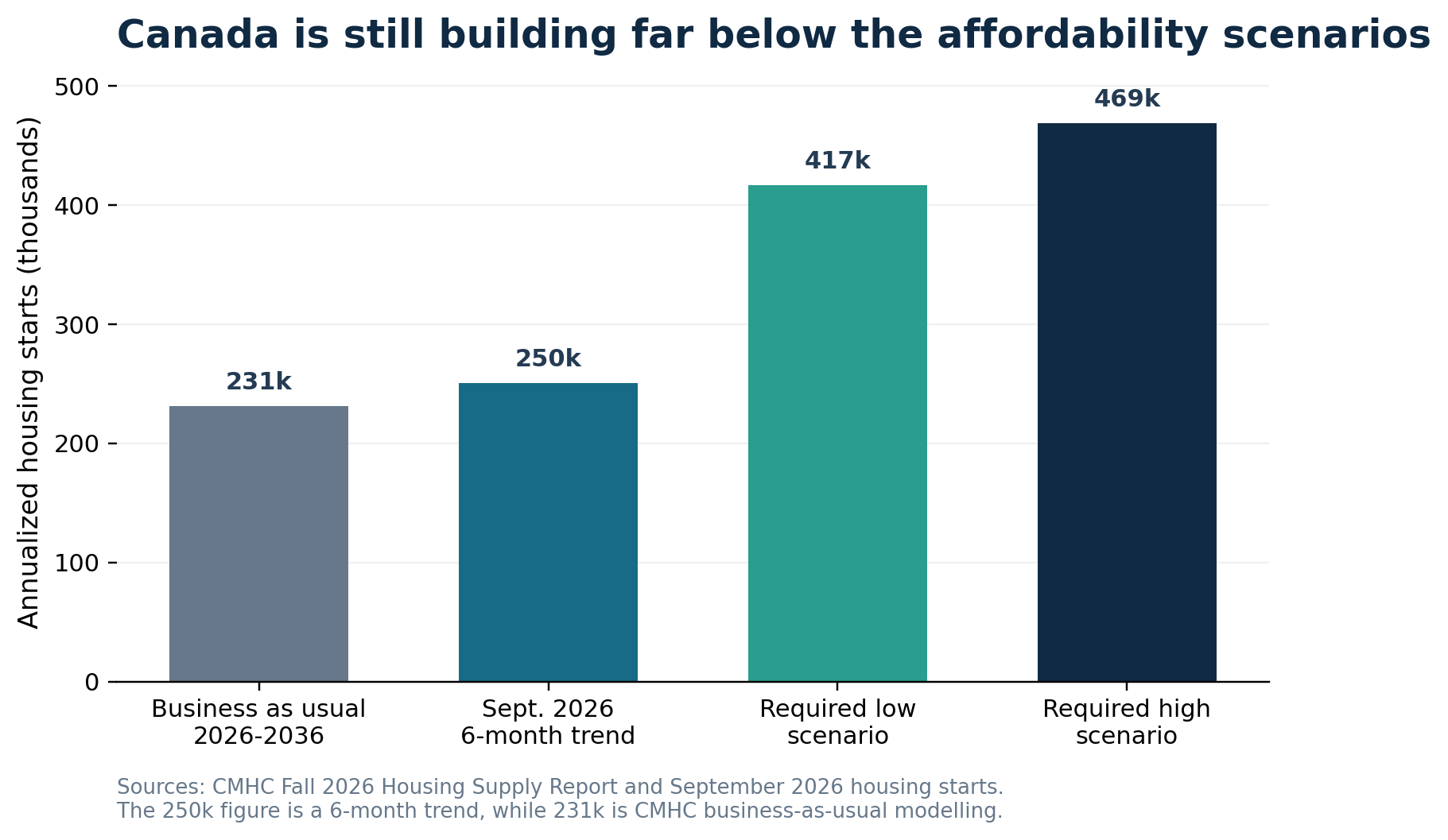
CMHC’s Fall 2026 work estimates that Canada needs roughly 417,000 to 469,000 housing starts per year through 2036 to restore affordability toward pre-pandemic levels. CMHC’s business-as-usual estimate is about 231,000 starts per year. The September 2026 six-month trend was about 250,000.
Canada needs more lanes, but adding lanes takes years. If traffic suddenly speeds up before the new lanes are finished, the congestion comes right back.
Another wrinkle: rental construction has been doing more of the heavy lifting while ownership-oriented projects, especially new condominium launches, have weakened. Building rental housing helps, but it does not automatically replace the supply of homes people hope to purchase.
Source: CMHC, Fall 2026 Housing Supply Report; CMHC, September 2026 housing starts data.
3. Leg 2: Canada is improving, but it is not the U.S.
The U.S. economy is currently stronger and hotter. Canada is moving forward, but it still has more slack, higher unemployment and a softer housing market.
| CANADA | UNITED STATES | |
|---|---|---|
| Economic growth | Canada: Q2 +3.3% annualized; Q3 tracking about +2% | U.S.: Q3 +3.4% annualized |
| Unemployment | Canada: 6.5% | U.S.: 4.2% |
| Inflation | Canada: CPI 3.1%; 2.2% excluding gasoline | U.S.: PCE 3.6%; core PCE 3.1% |
| Policy rate | Bank of Canada: 2.50% | Federal Reserve: 3.75% to 4.00% |
Canada’s recent growth is better than many expected, but the Bank of Canada still says there is excess supply in the economy and housing remains relatively weak. The U.S. is growing more strongly, with lower unemployment, but inflation is also more persistent.
The U.S. car has a stronger engine, but it is running hot. The Canadian car is moving, but with less horsepower. Unfortunately, Canada is also feeling some of the heat through energy costs, trade and financial markets.
Source: Bank of Canada, October 28, 2026; Statistics Canada, September 2026; U.S. Federal Reserve, BEA and BLS, October 2026.
4. Leg 3: Lower rates help, but they can restart the race
Bank of Canada research published in 2026 reaches a simple conclusion: housing demand tends to react to monetary policy faster than housing supply.
Monthly payments can improve. More buyers qualify. Existing borrowers may get relief. Developers may find financing easier. But buyers can return in weeks while new homes take years.
Buyer demand can cool and prices can soften. But mortgage payments rise, construction financing gets harder, projects can be delayed and stressed homeowners have less room.
Imagine a restaurant with 100 seats and 130 people waiting outside. Lowering rates is like giving more people a coupon to get in. It helps each customer, but it does not create 30 new tables by dinner time.
A lower mortgage rate can make the monthly payment easier while stronger demand pushes the purchase price higher. Those two things can happen at the same time.
Source: Bank of Canada staff analytical papers on housing demand, supply and monetary policy, 2026.
5. Leg 4: Canada does not fully control fixed mortgage rates
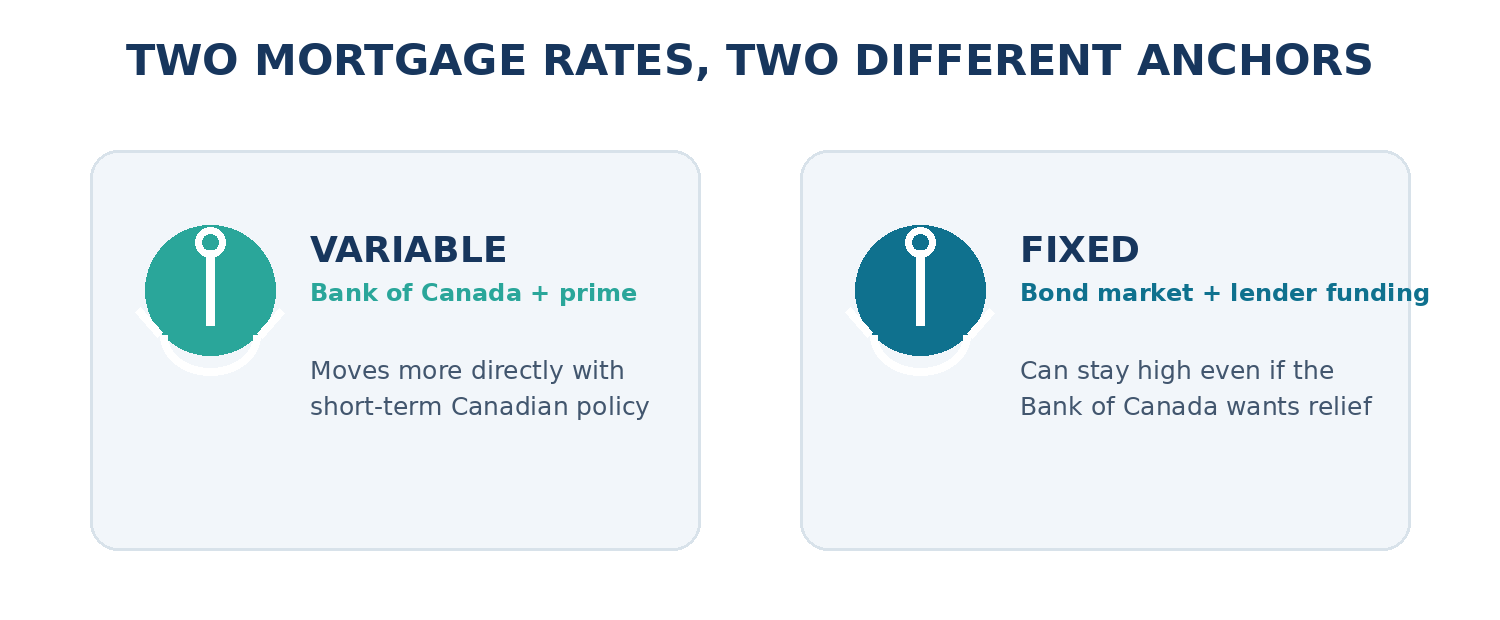
The Bank of Canada does not set mortgage rates. Its policy rate strongly affects prime and therefore variable-rate borrowing, but fixed mortgage pricing is also influenced by government bond yields, lender funding costs, competition and risk.
That matters because financial markets are global. Canadian lenders borrow in global markets, and Canadian bond yields react to what happens in the United States and elsewhere. A strong U.S. economy, sticky U.S. inflation and heavy global borrowing can keep bond yields elevated even if the Canadian economy would benefit from easier financial conditions.
Canada can steer differently from the United States, but the two financial systems are connected by a very strong rope. The Bank of Canada can cut its rate and Canadian fixed mortgage rates can still refuse to fall very much.
Source: Bank of Canada, “What’s behind your mortgage rate” and October 2026 Monetary Policy Report; U.S. Federal Reserve, October 28, 2026.
6. What if interest rates simply stayed where they are?
Stable rates could help the housing market stop guessing. Buyers would have less reason to wait for a dramatic cut. Sellers could adjust to current financing conditions. Builders could model projects with more certainty. Households could budget with fewer surprises.
If current rates are high enough to suppress buyer demand, they may also be high enough to suppress construction. Holding the steering wheel steady does not build the extra lanes.
Rates would not need to remain unchanged until 2036. CMHC’s 2036 horizon is about the time required to build and rebalance housing supply, not a recommendation that the Bank of Canada freeze interest rates for a decade.
A more realistic path is several forces improving together:
- more homes are built consistently, especially homes people can actually purchase;
- home prices rise more slowly than incomes for a period of time;
- employment stays resilient enough that households can carry their payments;
- borrowing costs become sustainable without reigniting a rush of demand;
- existing homeowners keep paying down principal and rebuilding their equity cushion.
7. Restoring 2019 affordability does not mean 2019 prices
CMHC is talking about restoring the relationship between housing costs and household income, not rewinding every Canadian home to its 2019 dollar value.
Affordability can improve in several ways at once. Prices can fall. Prices can stay relatively flat while incomes rise. Mortgage costs can improve. Owners can pay down principal. More supply can reduce the scarcity premium.
If a home that might otherwise have been worth $1.2 million in 2035 is worth $900,000 because Canada successfully adds supply, that does not mean today’s $800,000 homeowner lost $300,000. It means the home appreciated much less than it might have under continued scarcity.
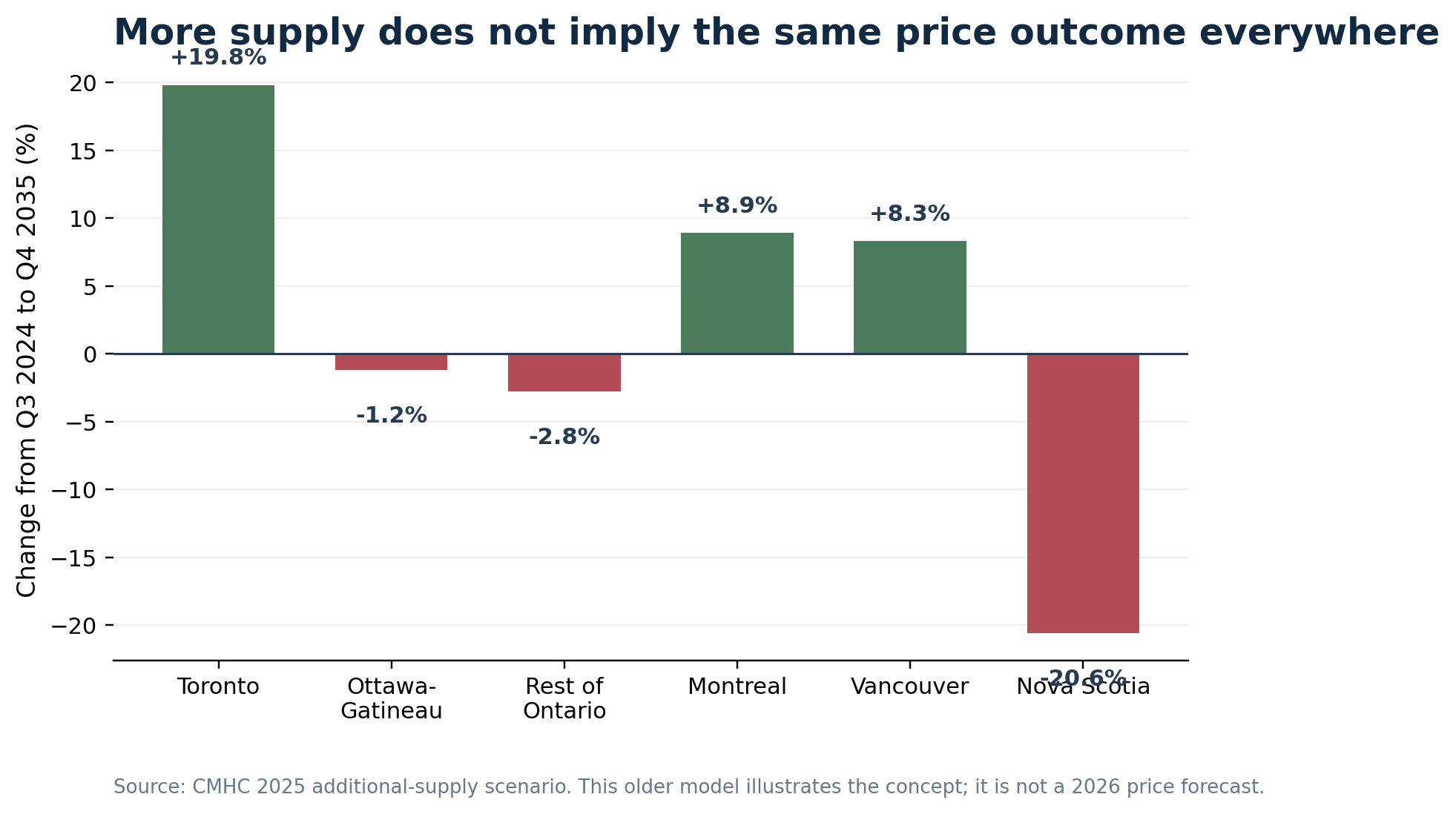
CMHC’s 2025 additional-supply scenario illustrated this point: national home prices in 2035 were roughly a quarter lower than they otherwise would have been, but regional outcomes varied and many markets still showed higher nominal prices than in 2024. That scenario is useful as an illustration, not as a current price forecast.
Source: CMHC, Canada’s Housing Supply Shortages: Moving to a New Framework, 2025.
8. What happens to existing homeowners?
More supply deliberately makes housing less scarce. That is good for future affordability, but scarcity has also supported existing property values. So yes, a successful housing build-out can mean slower appreciation, and in some markets actual price declines.
The most vulnerable owner is not necessarily the person who bought ten years ago with substantial equity. It is often the recent buyer who entered with a small down payment and then needs to sell during a price decline.
If your income is stable and you can keep making the payment, you may be able to wait while the mortgage balance falls. The danger arrives when life forces you to surface: job loss, divorce, relocation, illness, renewal difficulty or an urgent sale.
9. The high loan-to-value vulnerability
Consider a $500,000 owner-occupied purchase with 5% down. The base mortgage is $475,000. At a 95% loan-to-value ratio, a standard 4% mortgage insurance premium is about $19,000. If that premium is added to the mortgage, the starting balance is roughly $494,000.
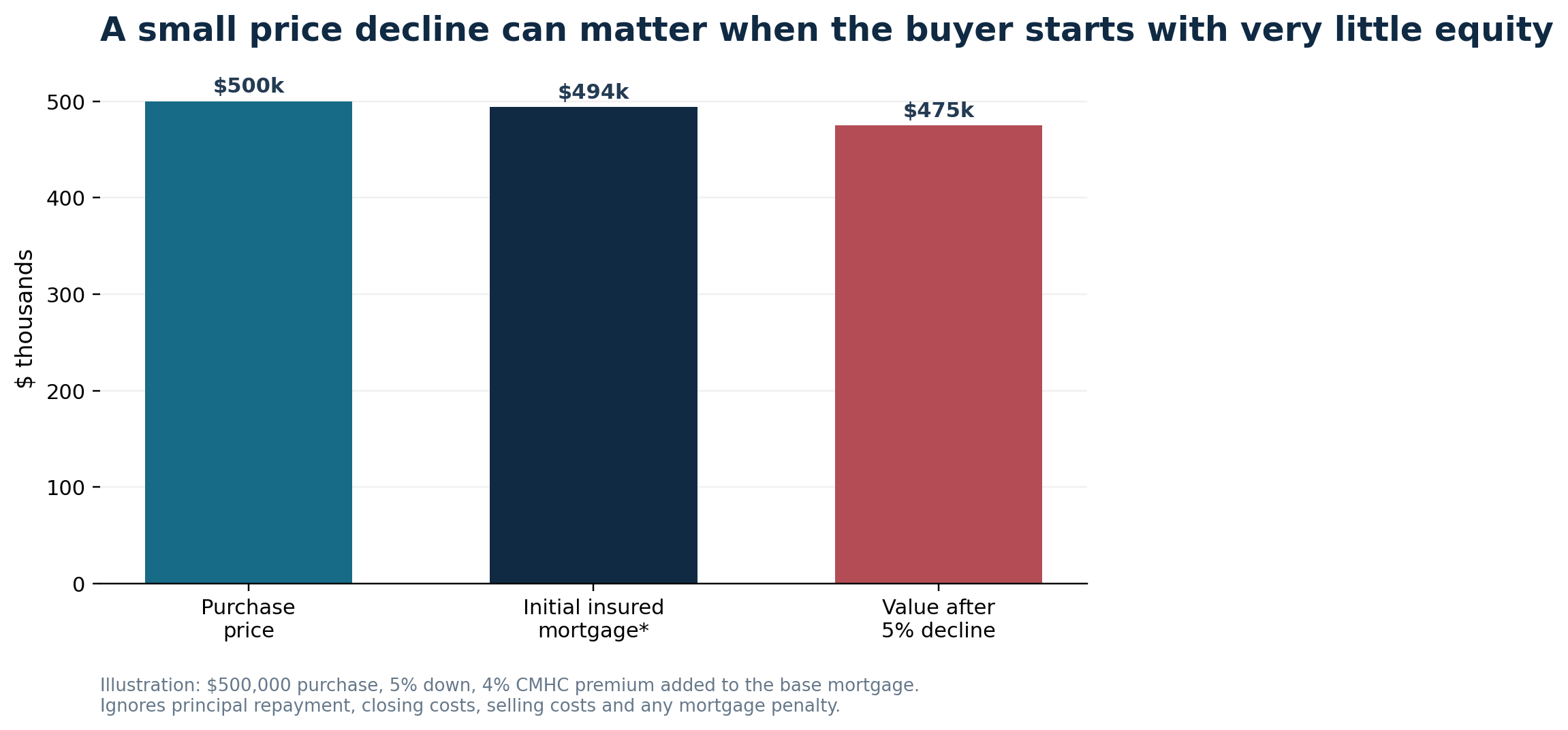
If the property value then falls 5% to $475,000, the borrower can temporarily owe more than the property is worth, depending on how much principal has already been repaid. Selling costs and any mortgage penalty can tighten the exit further.
Do not assume rising prices will create your equity for you. Make sure the plan still works if appreciation is slow, the home value dips temporarily, or you need to stay longer than expected.
Source: CMHC mortgage loan insurance premium information; Financial Consumer Agency of Canada down payment guidance.
10. The gentler path: let time do some of the work
Canada does not need a dramatic nominal housing crash for affordability to improve. A much gentler adjustment can happen if home prices grow slowly while household incomes rise and mortgage balances fall.
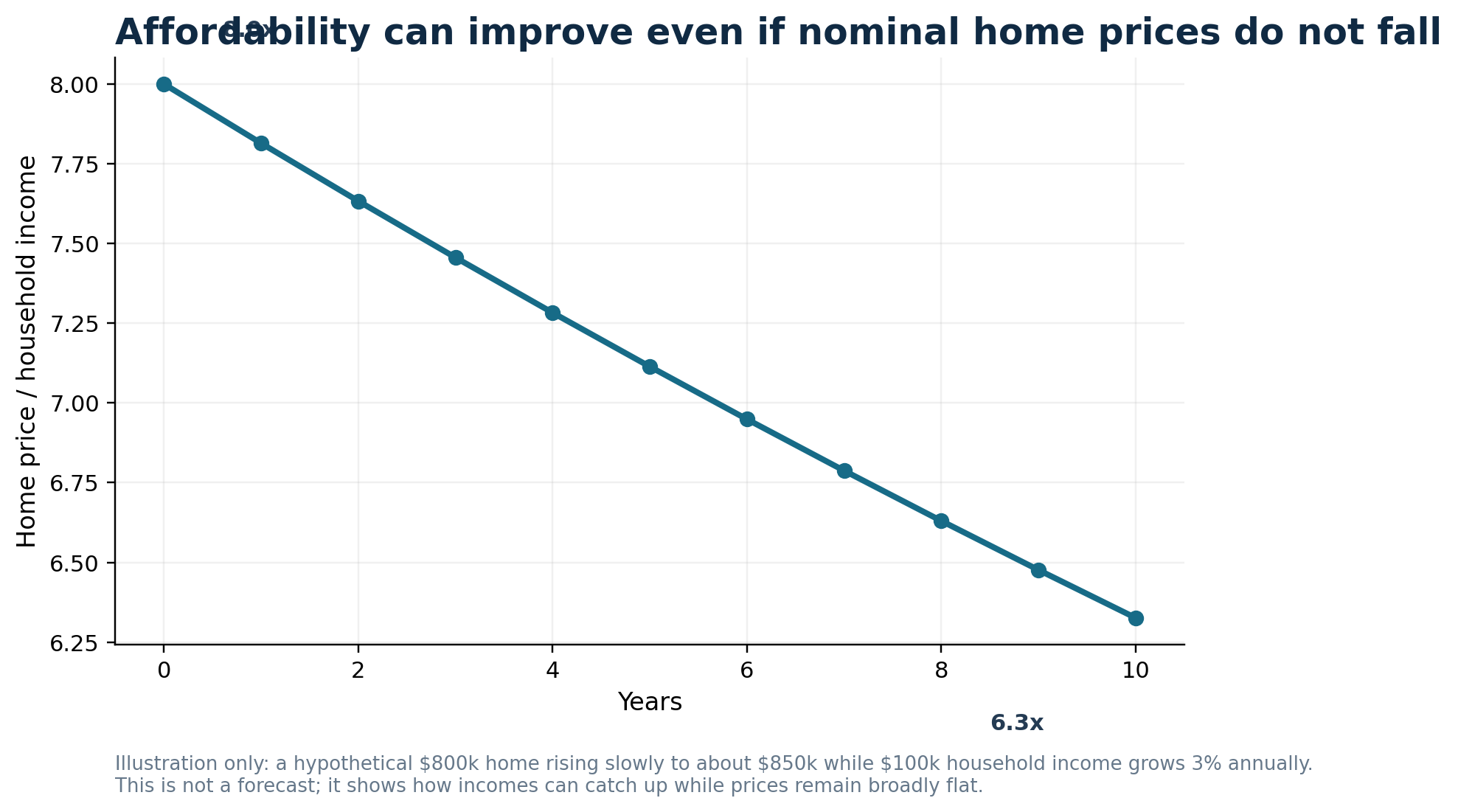
The example above is deliberately simple. A hypothetical $800,000 home rises slowly to about $850,000 over ten years while a $100,000 household income grows 3% per year. The price-to-income ratio falls materially even though the home never suffers a nominal price crash.
A decade where incomes, construction and principal repayment gradually catch up to home prices could repair affordability with far less damage than another boom-and-bust cycle.
11. What should Canadians actually do?
Make the decision work with today’s numbers, then treat future rate cuts or price gains as a bonus rather than a requirement.
Ask: Can I comfortably carry this payment today? Do not buy a home that only works if rates fall later. Keep room for repairs, taxes and life.
Assume appreciation may be slow. A thin equity cushion is not automatically dangerous, but it leaves less room if you must sell early.
Start early. Model several payment scenarios. Do not wait until the last minute hoping one Bank of Canada announcement will rescue the budget.
Understand the anchors. Variable is more directly tied to prime and Bank of Canada policy. Fixed is more exposed to bond markets. Choose based on cash flow, flexibility and risk tolerance, not one rate prediction.
12. More practical decisions for real households
Act while you still have choices. Equity, refinancing, amortization, debt consolidation or a voluntary sale are easier to evaluate before arrears, legal costs and deadlines reduce the options.
Remember that falling prices often arrive with weaker employment. A cheaper home is not necessarily easier to buy if your income becomes less secure.
Price against today’s comparable sales and today’s buyer financing capacity, not the peak price a neighbour received years ago.
A policy-rate change is only one piece of the puzzle. It can move variable rates much more directly than fixed rates. Watch the payment that is actually available to you, not just the headline.
The best question is not “What do I think rates will do?”
It is: “Will my decision still work if I am wrong?”
13. The Catch 22, in plain English
Canada needs more homes, but high rates can slow construction.
Canada needs relief for stretched borrowers, but lower rates can bring demand back faster than supply.
Canada would benefit from more affordable prices, but falling prices can trap recent high-LTV homeowners.
Canada can have a weaker economy and still face inflation pressure from energy and imported costs.
The Bank of Canada can want easier conditions, but global bond markets can keep fixed mortgage rates stubborn.
That is why there is no magic interest rate, no magic home price and no single policy that fixes housing.
More housing, especially ownership-oriented housing. Stable employment. Incomes that gradually catch up. Sustainable borrowing costs. Slower price growth. And enough time for homeowners to pay down principal and rebuild equity.
The goal is not to turn Canadians into economists.
It is to help people understand enough of the machinery that they can make a confident decision without gambling on one headline.
Sources and reading list
Primary sources are listed first. Better Dwelling and MortgageLogic are included as secondary commentary because they helped frame the questions explored in this report. Forecasts are identified as forecasts, not facts.
- CMHC, Fall 2026 Housing Supply Report
- CMHC, September 2026 housing starts and construction data
- CMHC, Residential Mortgage Industry Report
- CMHC, Canada’s Housing Supply Shortages: Moving to a New Framework (2025)
- Bank of Canada, Demand roars, supply whispers: Monetary policy and housing in Canada
- Bank of Canada, Conduct of Monetary Policy under Housing Market Imbalances
- Bank of Canada, What’s behind your mortgage rate
- Bank of Canada, Monetary Policy Report and rate decision, October 28, 2026
- Statistics Canada, Labour Force Survey, September 2026
- Statistics Canada, Consumer Price Index, September 2026
- U.S. Federal Reserve, FOMC statement, October 28, 2026
- U.S. Bureau of Economic Analysis, GDP advance estimate, Q3 2026
- U.S. Bureau of Economic Analysis, Personal Income and Outlays, September 2026
- U.S. Bureau of Labor Statistics, U.S. Economy at a Glance
- Better Dwelling, Bank of Canada Study Warns Rate Cuts Mostly Create Demand, Not Supply
- Better Dwelling, Canadian Real Estate Prices To Fall Even Further: Oxford Economics
- MortgageLogic, The Fed’s ‘Predictably Boring’ Hold, October 28, 2026
- CMHC, Mortgage loan insurance premium information
- Financial Consumer Agency of Canada, How much you need for a down payment
Prepared for educational use, October 29, 2026. Mortgage suitability, qualification and affordability depend on individual circumstances. Verify time-sensitive data before publication or client use.


